
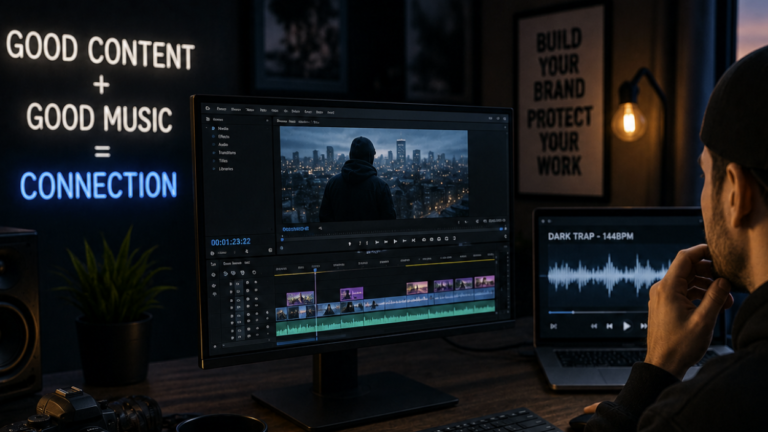
I have been making beats for over twenty years and one thing I have watched change dramatically is who is buying them. It is not just rappers anymore. YouTubers, indie filmmakers, TikTok creators, podcast producers, and short film directors are all looking for the same thing: high-quality music that will not destroy their channel the moment they upload it.
The fear is real. I recall talking to a filmmaker who spent weeks editing a short film, added a licensed beat from a random marketplace, uploaded it to YouTube, and woke up the next morning to a Content ID claim from a company he had never heard of. His monetization was gone. The beat he thought he had licensed was registered to a third party who had no connection to the producer he bought it from.
That situation is more common than it should be, and in this article I am going to explain exactly how it happens, what the difference is between a Content ID claim and a copyright strike, and how using RawHeatz beats keeps your channel protected in ways that most beat marketplaces cannot offer.
Who This Article Is For
Building a monetized channel and needing music that will not redirect your ad revenue to someone else the moment you upload.
Sourcing a cinematic hip-hop or trap score for a short film, documentary, or online release without a music supervisor budget.
Posting content with licensed music without triggering automated removals or account restrictions on short-form platforms.
Content ID vs Copyright Strike: The Difference That Changes Everything
I recall this being one of the most confused topics in every creator community I have ever come across. People use these terms interchangeably and they are completely different things with completely different consequences. Understanding this distinction will change how you think about music licensing for your content.
What a Content ID Claim Actually Is
YouTube's Content ID is an automated system that scans every video uploaded to the platform against a database of registered audio and video files. When a match is found, the rights holder receives a notification and can choose what to do with your video. The three options are to monetize it (taking your ad revenue), to track it (monitoring views without taking revenue), or to block it in certain territories.
Here is the critical thing most creators do not know: a Content ID claim is not a strike. It does not affect your channel standing. It does not put you at risk of termination. According to YouTube's own documentation, Content ID claims affect videos but usually do not impact your channel or account. The most common outcome of a music Content ID claim is simply that the monetization on that video goes to the rights holder instead of you.
What a Copyright Strike Actually Is
A copyright strike is a completely different and far more serious action. It happens when a rights holder files a formal legal removal request, not through Content ID but through a manual DMCA takedown. If the request is valid, YouTube removes your video and places a strike on your channel.
Three copyright strikes within 90 days means your entire channel is terminated and you are banned from creating new ones. That is the scenario creators are genuinely afraid of, and it is not what happens from a Content ID claim on a legitimately licensed beat.
| Content ID Claim | Copyright Strike |
|---|---|
| Automated system match | Manual legal removal request |
| Channel is NOT affected | Strike placed on channel |
| Monetization may redirect to rights holder | Video is removed |
| Video stays live | 3 strikes in 90 days = channel terminated |
| Can be resolved by whitelisting | Requires counter-notice or retraction |
A Content ID claim on a legitimately licensed beat will never terminate your channel. The worst realistic outcome is that one video does not earn ad revenue while the claim is active. A copyright strike is a completely different situation entirely.
The Hidden Danger: Third-Party Content ID Registration
Here is the scenario that actually damaged the filmmaker I mentioned at the beginning of this article, and as far as I know it is one of the most underreported problems in the independent beat industry.
When a producer does not register their own beats with Content ID, a gap opens up. That gap can be filled by anyone. A third party, a music aggregator, a collection society, or even a bad actor can register the audio fingerprint of that beat in Content ID without the producer's knowledge or consent. From that moment on, every video ever uploaded using that beat, including by creators who purchased a completely legitimate license from the original producer, will receive a Content ID claim from that third party.
You buy a beat from a producer who has no Content ID coverage. You upload your video. A third party who illegally registered that same audio fingerprint receives an automated claim against your video. Your monetization is redirected to someone who has no connection to the producer you paid. You have a valid license but the producer has no Content ID tool to whitelist you. Neither of you has an easy way to resolve it. The only party benefiting is the one who registered the work fraudulently.
This is one of the most important reasons to buy beats only from producers who actively manage their own Content ID registration. When the producer controls the Content ID asset, they can whitelist your video directly. When they do not, or when a third party has already claimed the fingerprint, the situation becomes difficult for everyone and sometimes impossible to resolve quickly.
How RawHeatz Handles Content ID for Buyers
Every beat I release on RawHeatz is registered under my own Content ID coverage from the moment it is uploaded. I control the asset. No third party can register my beats and redirect revenue away from my buyers, because the fingerprint is already in the system under my account.
All beats are registered with Content ID by me directly. No third-party gaps, no unauthorized registrations.
Buyers must notify me before publishing their video. Once you notify me with your video details, I whitelist your content in the Content ID system.
After whitelisting, your channel is fully protected. Even if a Content ID match is triggered before whitelisting is complete, your channel standing is never at risk. A claim affects monetization on the video only, never your account.
The whitelisting process is straightforward. Contact me through the store with your purchase confirmation and video URL before you publish, and I take care of the rest.
I recall setting this system up deliberately because I could see how much confusion and damage the Content ID situation was causing for creators buying beats from marketplaces with no producer accountability. When I have the Content ID tool in my hands, I can protect my buyers. When a producer does not have it, nobody can.
Can You Monetize a YouTube Video With a Leased Beat?
This is the question I get most often from YouTubers and the answer has a few layers to it.
If you purchase a lease from RawHeatz and notify me before publishing, I whitelist your video. Once whitelisted, the Content ID system will not redirect your monetization. Your video earns ad revenue normally. Your channel is untouched.
If you publish before notifying me, the Content ID system may automatically detect the beat and place a claim on your video. At that point the monetization on that specific video would temporarily redirect to me rather than you. Your channel is still completely safe, your account is not at risk, and the video stays live. Once you notify me and I whitelist it, the situation is resolved. The claim does not become a strike unless you dispute it without a valid reason, which you would have no reason to do because your license is legitimate.
This is why the notification step matters. It is not a gatekeeping mechanism. It is the step that puts the Content ID system in your favor before the automated process triggers against you.
The Indie Filmmaker's Guide to Sourcing Licensed Hip-Hop and Trap Music
As far as I know, one of the most underserved markets in music licensing is independent filmmakers who need a dark, cinematic hip-hop or trap score and do not have a music supervisor or a library budget. The mainstream sync licensing world is expensive and slow. AI music is legally dangerous. And most royalty-free libraries do not have the raw energy and production quality that actually works under the kind of visual content independent filmmakers are making in 2026.
Dark trap and plugg production sits in a sonic space that works extremely well for dramatic, tense, or atmospheric visual content. Heavy 808s under a cityscape. Atmospheric melodic pads under a character study. Hard drill percussion under an action sequence. I remember producing beats and thinking about the visual energy they carry, not just the vocal energy. That cinematic quality is built into the production from the start.
For indie filmmakers, here is what you need to know about using RawHeatz beats in your project:
- A standard lease covers online distribution including YouTube, Vimeo, and festival streaming. Check your specific license terms for broadcast and theatrical rights if your film is going to those platforms.
- Notify me before the film goes live so I can whitelist the audio on any platform where Content ID operates.
- For sync licensing to broadcast, streaming platforms like Netflix or Amazon, or commercial distribution, an exclusive license is the appropriate tier. Reach out before purchasing and I can advise on the right approach for your specific project.
- The premium stems tier gives your sound designer or composer the individual elements of the beat to work with, which is particularly useful for film scoring where you may need to isolate or rearrange elements to fit picture.
TikTok, Reels, and Short-Form Content
Short-form platforms handle music licensing differently from YouTube and the situation is evolving quickly in 2026. Here is what I know from experience and from watching how platforms are handling licensed music on short-form content.
TikTok and Instagram Reels both have their own Content ID-style detection systems. A basic lease from RawHeatz covers use in social media content. The notification and whitelisting process applies here as well. Contact me with your account handle and the content you are posting, and I can advise on the best approach for your specific platform.
One thing worth knowing: YouTube Shorts longer than one minute are now categorized under YouTube's standard Content ID rules. A short-form video over one minute with an active Content ID claim will be blocked rather than just monetization-redirected. This makes the whitelisting step even more important for Shorts creators than for standard long-form videos.
Dark trap production. Unlimited licensing. Notify me before publishing and I handle the Content ID whitelisting.
🔥 Browse RawHeatz BeatsStep-by-Step: Publishing a Video With a RawHeatz Beat Without Issues
Save your beat files and your license PDF in a dedicated cloud folder. The license document is your proof of purchase with a timestamp. You will need it if any dispute ever arises.
Complete your edit, color grade, mix, and export. Have the final version ready before the video goes anywhere public.
Send me your purchase confirmation and the URL or details of the video you are about to upload. I will whitelist the content in the Content ID system so the automated detection works in your favor from the moment your video goes live, not against you.
Once whitelisted, publish your video. Your monetization is yours. Your channel is protected. If for any reason a claim appears before whitelisting is complete, your channel is still fully safe. A Content ID claim affects one video's monetization temporarily, never your account standing.
Do not delete your license document after the video goes live. If a platform ever questions your right to use the music, a dated license PDF from the original producer is your complete answer. Keep it in your project archive alongside your beat files.
Plugg and atmospheric trap. Full stems on premium tier. Ideal for film scoring and cinematic content.
🔥 Browse RawHeatz BeatsCommon Questions About Beat Licenses for Content Creators
Can I monetize a YouTube video if the beat is leased?
Yes, provided you notify me before publishing so I can whitelist your video in the Content ID system. Once whitelisted, your monetization is fully yours. If a claim triggers before whitelisting, your channel is still safe and the situation is easily resolved. A Content ID claim on a licensed beat is never a channel strike.
What is the difference between a Content ID claim and a copyright strike?
A Content ID claim is automated and non-punitive. It may redirect ad revenue on a single video but does not affect your channel standing in any way. A copyright strike is a formal legal takedown. Three strikes within 90 days results in channel termination. Using a legitimately licensed beat from a producer who manages their own Content ID will never result in a copyright strike against your channel.
What happens if someone else illegally registers my licensed beat in Content ID?
This is why buying from a producer who already has Content ID coverage matters. Because all RawHeatz beats are registered by me directly, no third party can fraudulently claim the fingerprint after the fact. The asset is already in the system under my account. When I whitelist your video, my registration overrides any potential interference.
Can I use a leased beat in a short film or documentary?
A standard lease covers online distribution including YouTube, Vimeo, and festival streaming. If your film is heading to broadcast, theatrical release, or commercial streaming platforms like Netflix or Amazon, reach out before purchasing and I will advise on the appropriate license tier for your distribution scope.
Do I need to credit RawHeatz in my video?
Yes. Standard practice and license terms require producer credit in your video description. For example: Music: [Beat Name] prod. by RawHeatz — rawheatz.com. This is also good practice because it signals to platforms and any automated systems that the music is legitimately licensed, not randomly used.
Where can I find royalty-free hip-hop and trap beats for my content?
In my opinion the term "royalty-free" is one of the most misused in the music industry. It does not mean the music is free or that there are no rights involved. It means you pay a one-time license fee rather than ongoing royalties. RawHeatz offers exactly this model: one payment, unlimited use, no ongoing fees, and Content ID management handled directly by me. Browse the full catalog at rawheatz.com.
Content ID claim: video stays live, channel is safe, monetization may redirect temporarily. Resolved by whitelisting.
Copyright strike: video removed, channel at risk, three strikes means termination. This does not happen from a legitimately licensed beat.
The fix: buy from a producer who manages their own Content ID. Notify before publishing. Get whitelisted. Publish with full protection.
Human-made dark trap, drill, and plugg beats. Unlimited licensing. Content ID managed directly. Notify me before publishing and your channel stays protected.
🔥 Browse RawHeatz Beats